Free Apps Sun Protection Android & iOS
stop pretending. Your phone can tell you exactly when the sun becomes a problem.
Two free apps – one tracks live UV levels and tells you how long your skin can withstand it, the other shows what years of unprotected sun exposure can do to your face. It is advisable to consume both before the peak of summer.
🆓 Completely free
📱 Android and iPhone
🌍 Works worldwide
⏱️ Sunscreen Reminder

Sunshine is wonderful – right until it isn’t. An afternoon at the beach or an hour of outdoor cricket without sunscreen can ruin weeks of careful skin care. The problem isn’t that people don’t know that UV radiation is dangerous; It’s when the sun just looks bright and happy that the danger seems abstract.
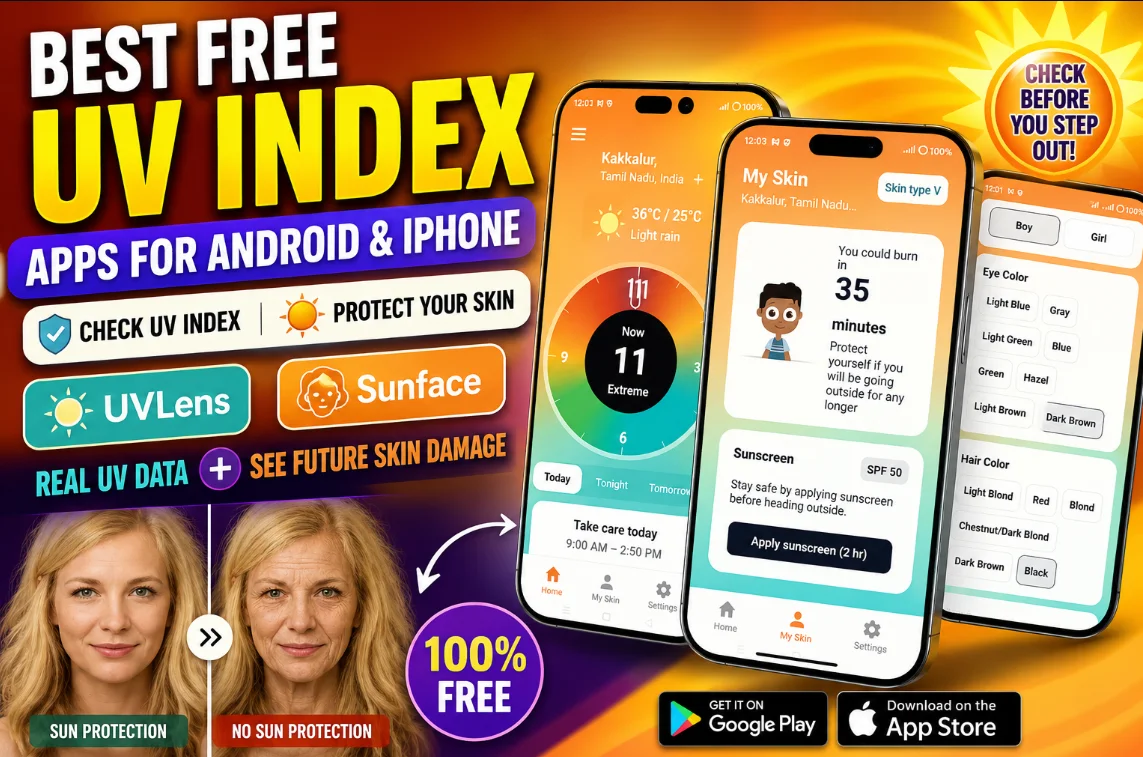
That’s where two quietly excellent free apps come in. UVLens Pulls real-time UV index data for wherever you are right now and calculates a personalized sunburn countdown based on your specific skin type. sunface uv selfie Something more subtle works – it takes your real face and shows you what it might look like after you’ve left years of protection behind.
No app can replace sunscreen. But together, they can get you to it more reliably.
Quick Read – 60 seconds
- UVLens: Free app for Android and iOS. Shows the live UV index for your location, estimates how long your skin type can safely withstand direct sunlight, and reminds you to reapply sunscreen. Is a home screen widget.
- Sunface UV Selfie: Free app for Android and iOS. Upload your photo and see a simulated preview of what years of UV exposure can do to your face – a compelling sight to take sun safety seriously.
- UV index 3 or above = Time for sunscreen, sunglasses and shade. These apps help you capture that moment before it’s too late.
- Both apps are free to download, require no subscription, and work globally, including India.
- Apps provide information – they don’t protect your skin. Physical measures (SPF 30+, hat, shade) are still necessary.
What the UV Index Really Means (and When to Start Caring)
The UV Index is a standardized number that tells you how strong ultraviolet radiation is at a given time and location. This affects the angle of the sun, cloud cover, altitude, thickness of the ozone layer and a few other variables – so a clear summer afternoon in Chennai or Hyderabad will be very different from a cloudy January morning in Shimla.
1-2Less
3-5medium
6-7High
8-10Very high
11+extreme
Most dermatologists and public health bodies recommend protective measures — sunscreen, hats, sunglasses, or moving into the shade — when the index hits. 3. At ages 6 and older, protection is not optional, regardless of your skin color. At ages 11+, unprotected pale skin can begin to burn in less than 10 minutes.
The problem is that most of us have no intuitive sense of where the index sits on any given day. UVLens fills exactly this gap.
UVLens: Your personal sunburn countdown timer

UVLens does something that most weather apps don’t bother with: it makes the UV index personalized. Instead of just showing you a number, it asks about your skin type and uses it to calculate how many minutes of unprotected sun exposure your skin can last before things go wrong. For most people the countdown from time to burn is actually more useful than the raw UV numbers.
The app pulls up an all-day UV forecast for your current GPS location, so you can see when the index peaks and plan outdoor activities around it. It’s generally safer to go on a morning walk than an afternoon walk – and UVLens makes that change clear at a glance.
📍 Location-based UV forecast
⏱️ Skin-type countdown timer
🔔Sunscreen reapply reminders
🪟 Home Screen Widget
🌤️Cloud and UV daily graph
There is a sleeper feature to remind you to reapply sunscreen. This seems minor until you’ve been at the beach or on a hiking trail for three hours and completely forgot to reapply. Set a one-time reminder based on your SPF and current UV level, and the app prompts you at the right interval.
There’s also a home screen widget that displays the current UV Index without even opening the app – one glance before you step outside gives you everything you need to decide whether to grab sunscreen or not.
💡 Pro Tip
Set up UVLens’ home screen widget during the summer and place it right next to your weather widget. Checking the temperature is habitual – this way you will inadvertently check the UV as well. A 10-second glance every morning can change your sunscreen habits within a week.
Sunface UV selfie: what your face could look like in 10 years

Sunface takes a radically different angle. Rather than tracking live UV data, it answers a more personal question: What does years of unprotected sun exposure actually do to the face? not in the abstract – to Yours Face, based on the photo you uploaded.
The app simulates UV-related aging over several time periods. You can see what results 5, 10, or more years of consistent, unprotected sun exposure can cause – fine lines, pigmentation changes, texture changes. The simulation is not, and is not meant to be, medical imaging; Think of it as a vivid reminder of yourself, presented in your own likeness rather than a stock photo model.
📷 Works with your own portrait photos
📅 Multiple time period simulation
🔒 No account required
📤Easy share/save results
Where UVLens is an everyday utility tool, Sunface is a one-time wake-up call — one you share with a teen who thinks sunscreen is useless, or use to finally convince yourself to stop skipping it on cloudy days. Apart from being an app, it is also a conversation starter.
SunFace is not a substitute for medical advice or dermatological examination – this should be clear. But as a motivational prompt to form better habits, it’s actually more effective than a wall of statistics about skin cancer risk percentages.
UVLens vs SunFace – Which One Should You Install?
The honest answer is both, because they solve completely different problems. But if you’re deciding where to start, here’s a side-by-side comparison:
| Speciality | UVLens | sunface uv selfie |
|---|---|---|
| primary purpose | Daily UV monitoring and sun protection time | Visual inspiration through UV aging simulation |
| real time uv data | ✔ Yes, GPS-based | ✘ no |
| individual skin type input | ✔ Yes – affects countdown | ✘ N/A |
| sunscreen reminder | ✔ yes | ✘ no |
| home screen widget | ✔ yes | ✘ no |
| Uses your own photos | ✘ no | ✔ yes |
| Great for kids/teens | ✔ yes | ✔ very much |
| use frequency | daily (utility) | once or twice (motivational) |
| price | Free | Free |
Practical Sun Protection Tips That Really Work
Apps can give you information, but certain habits make the difference between knowing and doing:
Sunscreen SPF 30+ is the baseline For moderate to high UV conditions. Apply it 20 minutes before going outside and reapply every two hours or immediately after swimming or heavy sweating – whichever comes first. UVLens will remind you, but you still need to keep the bottle within reach.
Cloudy days are not safe days. Up to 80% of UV radiation passes directly through clouds. If the UVLens widget shows a reading above 3, safety rules apply, regardless of whether the sun is visible or not.
The afternoon window is a danger zone – From approximately 10 am to 4 pm when the sun is at the highest and UV radiation is most intense. Planning outdoor activity outside that window is often the simplest and most effective safety strategy available.
Children and people with light skin require extra care. The skin type setting for UVLens exists precisely because burn times vary dramatically – someone with very fair skin can start burning in less than 10 minutes at a high UV index, while someone with a darker skin tone has a longer window but is not immune to long-term UV damage.
Sunglasses and body coverage also matter. UV radiation affects your eyes as well as your skin. Wrap-around sunglasses with UV400 protection are the simple solution out there.
If you’re interested in free health and screen-wellness apps for Android, our Twilight Blue Light Filter review is worth a read – it tackles the evening equivalent of sun damage: the blue light that disrupts your sleep after dark.
our decision
Both free, both worth installing – for different reasons
UVLens Earns a permanent place on your home screen. The live UV index, skin-type-adjusted burn countdown and sunscreen reminder make this a really useful daily protection tool – no novelty. If you spend any meaningful time outside, it belongs in your toolkit in the same way a weather app does.
sunface uv selfie This is the push you share with someone who needs convincing. Seeing the potential effects on your face is more motivating than any statistic. Install it, use it once or twice, share the results with your family – then let UVLens handle the day-to-day work.
Neither does it cost a single rupee. There is no reason not to have both.
Frequently Asked Questions
What is UV Index and why does it matter?
The UV index is a standardized scale measuring the intensity of ultraviolet radiation at a specific time and location. Higher numbers mean faster skin damage. Most health officials recommend protective measures – sunscreen, shade, protective clothing – when the index reaches 3 or above.
Is UVLens free to download?
Yes, completely free on both Google Play and Apple App Store. No subscription, no in-app purchases required to access the UV forecast, personalized sunburn countdown, or home screen widgets.
What exactly does Sunface UV Selfie App do?
You upload a portrait photo and SunFace simulates what your face might look like after prolonged, unprotected UV exposure over different time periods. It’s a visual stimulation tool – not a medical diagnosis – designed to make long-term sun damage feel personal and real rather than abstract.
Can UV apps replace sunscreen?
Absolutely not. These apps provide information – UV levels, burn timers, visual reminders – but offer zero physical protection. Sunscreen (SPF 30+), shade, hat and sunglasses are the real protection. Apps help you know when and how to use them.
At what UV index should I start applying sunscreen?
The standard recommendation is UV index 3. At that level and above, damage to unprotected skin can occur, especially during prolonged outdoor exposure. At index 6 and above, protection is essential for all skin types.
Do these apps work in India?
Yes. UVLens uses GPS to pull location-specific UV data, so it works accurately across India – Chennai, Hyderabad, Bangalore, Mumbai, Delhi, and everywhere in between. During peak summer in India UV levels can regularly reach 9-11, making the UV monitoring app especially useful for anyone spending time outside between 10am and 4pm.
Learn more from Techno360
Subscribe to get the latest posts delivered to your email.