
Google recently introduced support for its VPN service for all Google One plans. Previously, only those customers who subscribed to the 2 terabyte plan. what is available For $9.99, there was access to a VPN. Now, all paying customers, including those paying $1.99 per month for the Basic plan, get access to the VPN.
Access to a VPN for $1.99, plus extra storage, better customer support, and a few extra features; On paper this appears to be a good deal for users invested in Google’s ecosystem.
Google promises that its VPN “does not use your VPN connection to track, log, or sell your online activity.” In 2021, Google hired NCC Group audit VPN by Google One. The focus of the audit was to “assess the technical security properties of the product and review its associated privacy claims”.
The NCC Group provided the following summary regarding the privacy claims: “To meet its privacy claims, the product introduces supplemental cryptographic measures to isolate the Google user’s identity from tunneled VPN traffic. While these measures do not explicitly eliminate the opportunity for Google to circumvent its privacy claims, they do provide a structural framework within which applications can provide authentication and authorization for users without sending identity information to VPN exit nodes. Could”.
Google Limit Access to its VPN is currently limited to select regions. It currently supports 22 countries, including Germany, France, Canada, the United Kingdom, the United States, Taiwan, and Japan. Customers living in these countries get access to the VPN when they sign up for a paid Google One plan. For example, these customers can also use a VPN when traveling to other countries and regions.
VPN by Google One is available for mobile operating systems Android and iOS and desktop operating systems Windows and macOS. Customers can use the VPN on up to six devices.
VPN use by Google One
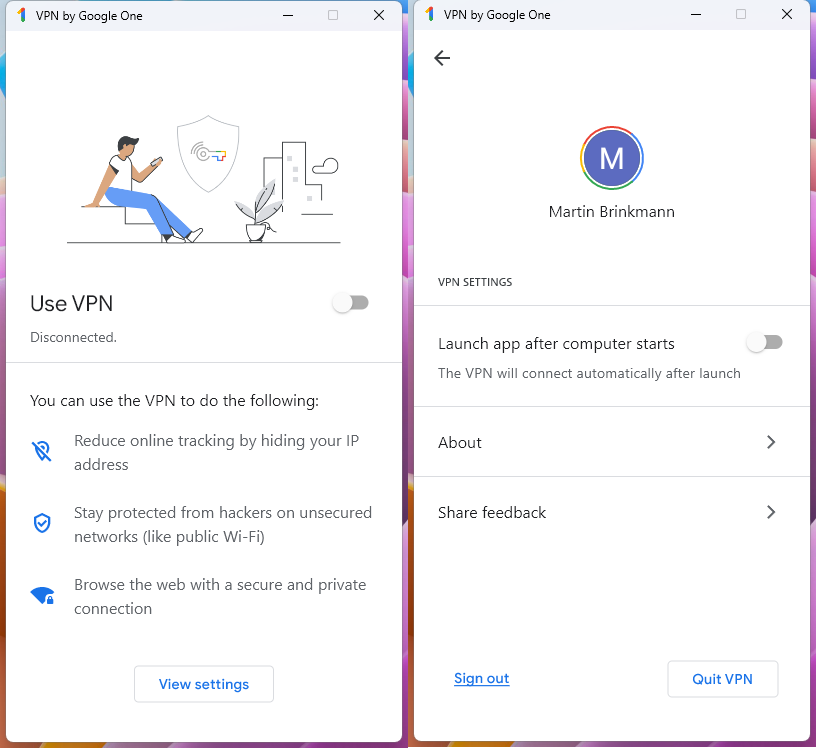
Google One customers who install VPN software on their desktop systems may be disappointed by the lack of options it offers. It features an on-off switch prominently, and a look in the settings reveals only one option: launching the app when the computer starts, so that the VPN connection is established immediately.
The desktop application lacks the features that the mobile version supports. The mobile Google One application offers two additional features:
- Bypass VPN connection for selected applications.
- Block the Internet connection if the VPN connection stops.
That’s all on that front.
The app lacks any other options. Connections are automatic, and there is no option to select the target region or country for the connection. Google also does not display the connected country or any other connection information.
There’s no option to select a protocol for the connection, enable security features, or use advanced options, like chaining VPN servers or something like NordVPN’s meshnet feature. There’s also no option to automatically connect to the VPN or set up a custom DNS provider under certain conditions.
Google’s VPN protects a user’s IP address and data while active; This prevents ISPs from collecting and selling traffic data, or checking what the user is doing. VPNs cannot be used for other common activities, such as bypassing geographic restrictions, or P2P downloading.
concluding words
VPN by Google One lacks most of the features offered by popular VPN solutions. Although it is still adequate for some use cases, notably protecting Internet traffic and user privacy by hiding device IP, it lacks even the most basic features.
Now you: Do you use VPN?